
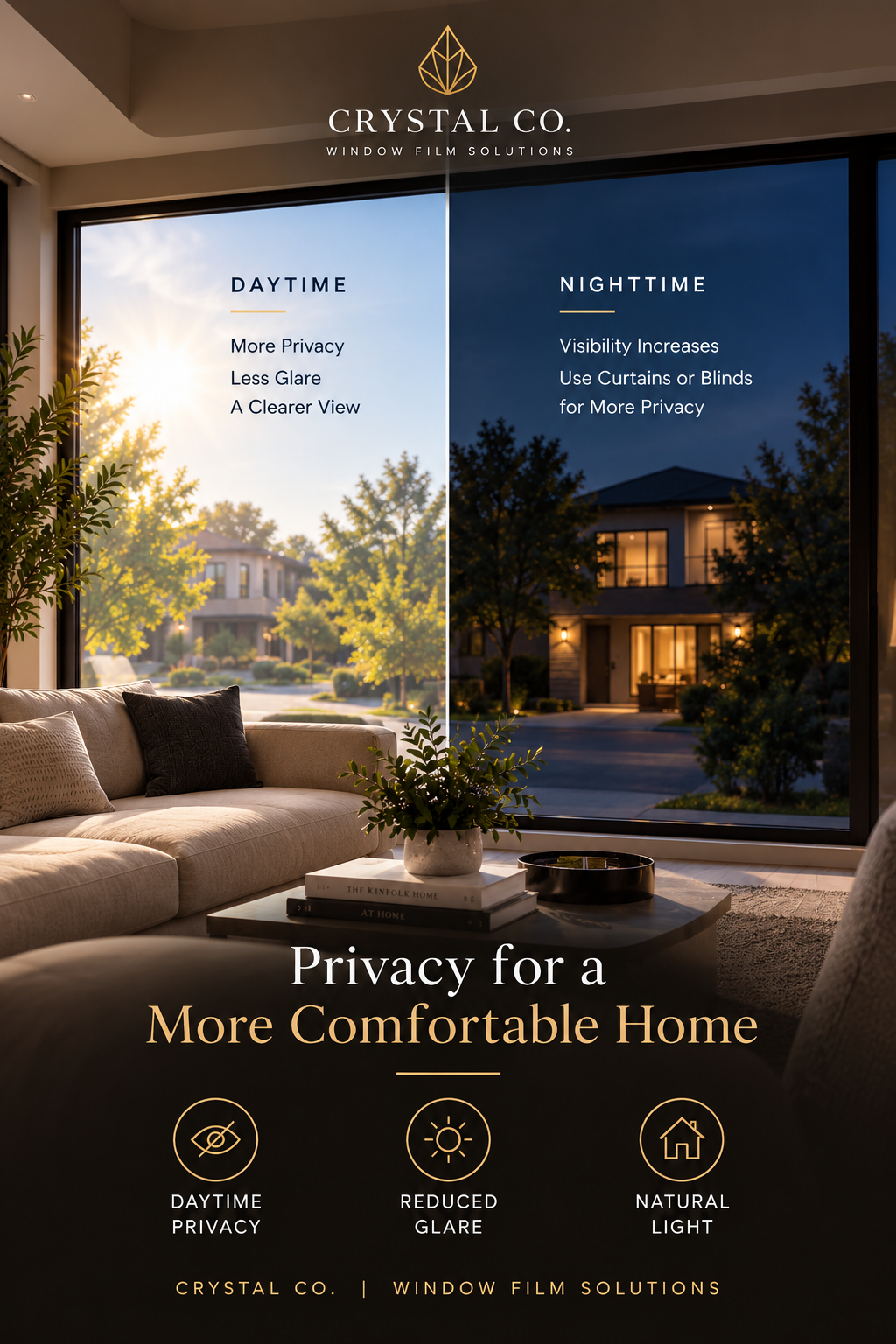
Privacy is one of the main reasons homeowners consider window film, especially for street-facing windows, ground-floor rooms, entryways, living spaces, and large glass areas. But there is one important question that should be answered before choosing a film:
does privacy window film work at night?
The short answer is that many privacy-oriented window films work best during the daytime, when the outside of the glass is brighter than the inside. At night, when interior lights are on and the exterior becomes darker, that lighting relationship can reverse.
This means a film that provides useful daytime privacy may not provide the same level of privacy after dark. Understanding this difference helps homeowners choose the right film and avoid unrealistic expectations.
How Does Privacy Window Film Work?
Privacy window film changes the way glass looks or behaves under certain lighting conditions. Depending on the film selected, it may make the glass more reflective, darker, frosted, patterned, or visually obscured.
Reflective films are especially dependent on the difference in brightness between the two sides of the glass. When daylight outside is significantly brighter than the interior, the exterior surface can appear more reflective and make it harder to see inside.
This is why daytime privacy window film can be effective for homes with exposed windows while still allowing occupants to maintain a view toward the outside in suitable conditions.
Does Privacy Window Film Work at Night?
Privacy film does not automatically provide the same privacy at night that it provides during the day.
When the interior of a home is brightly lit and the exterior is dark, people outside may be able to see through the glass more easily. In those conditions, the reflective effect that helped provide daytime privacy can be reduced or reversed.
This is especially important for living rooms, kitchens, bedrooms, and other areas where interior lighting remains on after sunset.
Homeowners who need dependable nighttime privacy should therefore consider complementary options such as blinds, curtains, shades, or a different type of privacy treatment.
Why Lighting Conditions Matter
The amount of privacy created by reflective window film depends heavily on which side of the glass is brighter.
During the Day
Daylight usually makes the exterior much brighter than the interior. Under these conditions, reflective film can create a more mirrored appearance from outside while allowing useful outward visibility from inside.
At Night
Once the sun goes down, interior lighting may become brighter than the exterior. The glass can then become easier to see through from outside.
For this reason, claims such as “complete one-way privacy day and night” should be treated cautiously unless the specific product and installation conditions genuinely support that result.
Is One-Way Window Film Really One Way?
The phrase “one-way window film” is commonly used in marketing, but it can create the wrong impression.
In most practical residential applications, the apparent one-way effect depends on lighting conditions rather than the film creating permanent one-direction visibility.
When the outside is brighter, the film may provide useful outward visibility and reduced inward visibility. When the interior becomes brighter, the effect may change.
So when considering one way window film at night, it is better to think in terms of controlled daytime privacy rather than guaranteed 24-hour one-way privacy.
Which Windows Benefit Most From Privacy Film?
Privacy window film for homes can be useful in several situations where maintaining natural light matters but exposed glass creates an uncomfortable level of visibility.
Common applications include:
- Street-facing living room windows
- Ground-floor windows near sidewalks or neighbours
- Front-door sidelights
- Entryway and foyer glazing
- Home offices
- Large living-room windows
- Basement windows
- Patio and glass doors
- Bathrooms using suitable privacy-oriented films
- Windows facing neighbouring properties
The correct film depends on how much privacy is required, whether the homeowner wants to maintain an outward view, how much natural light should remain, and how the room is used during the day and evening.
Reflective Privacy Film vs. Frosted Privacy Film
Not all privacy films work in the same way. Two common approaches are reflective film and frosted or obscuring film.
Reflective Privacy Film
Reflective film can help improve daytime privacy while preserving an outward view under suitable lighting conditions. It may also provide other benefits depending on the selected film, including glare and solar heat management.
Its privacy effect, however, is strongly influenced by lighting conditions.
Frosted or Obscuring Film
Frosted films provide privacy by obscuring the view through the glass rather than relying primarily on reflectivity.
This can make them more appropriate for windows where maintaining a clear outward view is less important, such as bathrooms, sidelights, partitions, or selected entryway glass.
Because different products create different levels of obscurity and light transmission, the desired result should be discussed before installation.
Can Privacy Film Still Let in Natural Light?
Yes. Privacy does not necessarily mean turning a room dark.
Films are available in different shades, reflectivity levels, and visible-light transmissions. A homeowner may want a relatively subtle film that maintains a bright room, while another property may require stronger glare control or greater visual separation.
The right balance depends on the existing room, window orientation, exterior exposure, and the level of privacy the homeowner expects.
Privacy Film Can Also Help With Heat and Glare
Some privacy-oriented films also provide solar-control benefits. Depending on the product, the same film may help reduce distracting glare and manage part of the solar heat entering through the glass.
This can be useful for rooms where privacy is only one part of the problem.
For example, a street-facing living room may experience direct sunlight, glare on a television, excess afternoon heat, and unwanted visibility from outside at the same time.
In that situation, the best film is usually selected based on the overall combination of privacy, glare, solar control, natural light, and appearance rather than a single feature.
You can also read our guide on how window tinting can help with heat and glare for a more detailed explanation of solar-control applications.
Home Window Tinting for Privacy
Professional home window tinting for privacy starts with understanding the problem the homeowner wants to solve.
A window facing a busy sidewalk may need a different solution from a bathroom window, a large living-room wall, or an upper-floor bedroom.
Crystal Co. provides residential and commercial window-film installation for properties where privacy, glare, solar heat, natural light, or visual comfort are concerns.
Learn more about our Residential & Commercial Window Tinting service.
What About Commercial Privacy Window Film?
Privacy window film is also useful in commercial environments where large areas of glass create visibility, glare, or comfort concerns.
Potential applications include:
- Office meeting rooms
- Reception areas
- Street-facing offices
- Retail storefronts
- Restaurants and cafés
- Clinics and professional spaces
- Interior glass partitions
- Showrooms
Commercial projects may prioritize a combination of privacy, glare reduction, appearance, and solar comfort while maintaining a professional visual style.
Privacy Film vs. Security Film
Privacy film and security film should not be treated as interchangeable products.
Privacy-oriented window film is primarily selected to influence visibility, glare, solar heat, appearance, or comfort.
Security film is primarily considered when glass-fragment retention and added resistance after impact are the main goals.
If the priority is glass protection rather than visibility, explore Crystal Co.’s Professional Window Security Film Installation.
How to Choose the Right Privacy Film
Before choosing a film, consider four main questions.
How Much Privacy Do You Need?
A partially exposed living room may require a different level of privacy from a bathroom or front-door sidelight.
Do You Want to Keep an Outside View?
Reflective films may preserve a useful outward view during suitable daytime conditions, while frosted film intentionally obscures visibility through the glass.
Do You Need Nighttime Privacy?
If reliable privacy after dark is essential, the window treatment should account for interior lighting and may need to be combined with blinds, curtains, or shades.
Are Heat or Glare Also a Problem?
If the room is also uncomfortable because of sunlight, a film with appropriate solar-control characteristics may be more useful than choosing a privacy film based only on appearance.
Frequently Asked Questions
Does privacy window film work at night?
Many reflective privacy films work best during daylight. When the inside of the home becomes brighter than the outside at night, visibility into the property can increase.
Can people see through privacy film from outside?
It depends on the film and lighting conditions. Reflective film can reduce visibility from outside during suitable daytime conditions, but the effect can change after dark.
Is there a window film that gives privacy day and night?
Frosted and obscuring films can provide more consistent visual privacy because they do not rely primarily on a reflective lighting effect. However, they also reduce or eliminate a clear view through the treated area.
Does privacy film make a room darker?
The effect depends on the selected film. Products vary in shade and visible-light transmission, so privacy and natural light can often be balanced according to the room and desired result.
Can privacy film reduce glare?
Certain films can reduce visible-light intensity and help control glare. Performance depends on the specific film selected.
Can privacy film be installed on existing windows?
In many suitable applications, yes. The existing glass and the selected film should still be reviewed for compatibility before installation.
Is privacy window film suitable for commercial properties?
Yes, depending on the application. Offices, meeting rooms, reception areas, storefronts, restaurants, and other commercial spaces may benefit from privacy-oriented film.
Find the Right Privacy Film for Your Windows
Tell us which windows need more privacy and whether heat, glare, natural light, or nighttime visibility are also concerns. Photos can help us understand the space and recommend the appropriate next step.